A military-based approach to hunting South Dakota pheasants: a role-based tactic for groups working late-season birds.
Originally written by Chris Hitzeman, published April 5, 2007.
Where the Idea Came From
If you've never been pheasant hunting in South Dakota, you might not understand the value of the tactics I'm about to describe. Having grown up pheasant hunting in the state of Iowa, I got used to losing birds out the end when hunting with small groups, and late season birds running up ahead with your shorthairs in hot pursuit. If I had a dime for every time the dogs would flush significant quantities of birds up at several hundred yards out of range, I'd be rich. After walking all day, the frustration factor could get high.
Maybe I'm narrow on this, but my respect for the craftiness and cunning of a truly wild mature ringneck is so high that, as long as the sole hunter and huntee are in the field void of motor vehicle and radio use, any legal tactic is ethical when it comes to bagging native wild pheasants. If you think different, you might not have attempted to get up on a couple hundred pheasants (that's 400 eyeballs) in a stripped out cornfield in mid December. When you witness several dozen roosters flushing way out of range ahead of you, you'll think "fair chase" is anything but fair.
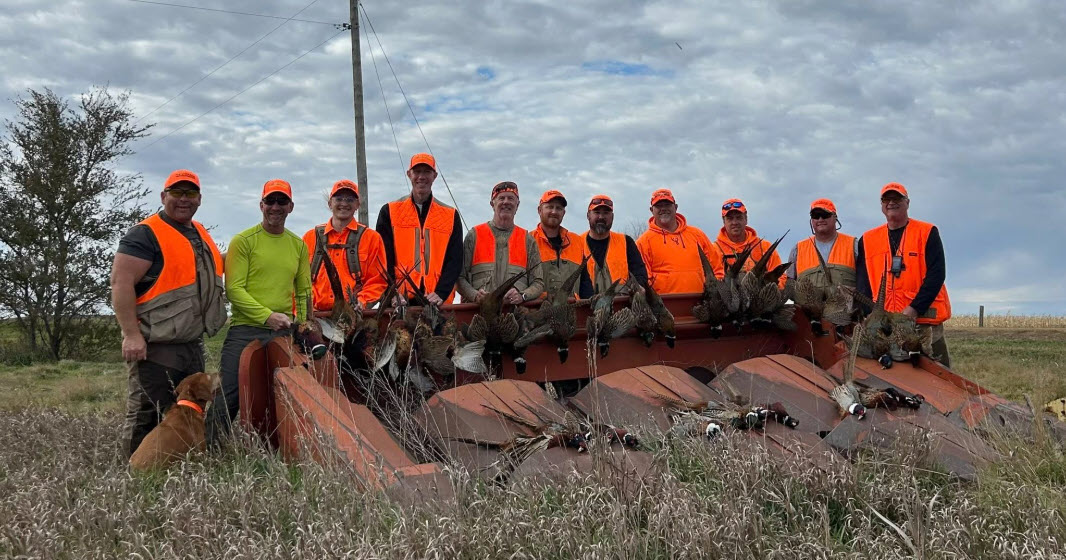
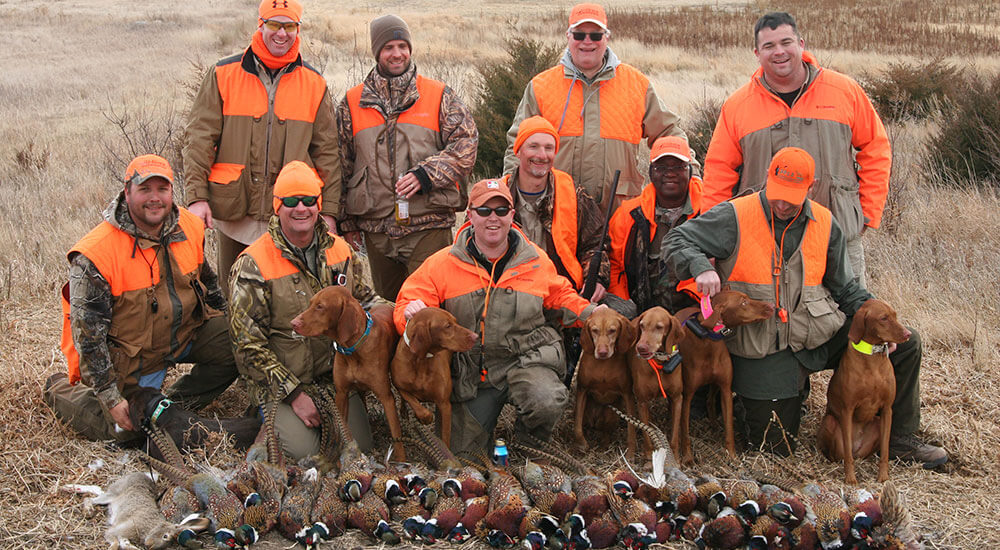
That was my experience while hunting this last fall of '06 near Choteau Creek, South Dakota, in a half section of CRP and stripped corn. We weren't totally familiar with all the cover on the ground and didn't quite know how to hunt the parcel. We had about 10 guys and about half a dozen dogs. We opted to enter the field from the south, walking into the wind in one big line abreast. As soon as we entered the field, birds started lifting out of the cover ahead of us, pheasant after pheasant flushing just out of range. This continued for about ¼ of the way down the field. The frustration factor started setting in. This isn't what we came to do. Seeing birds is great but getting some is OK too.
One of our issues was that no one person was leading the group in the hunting effort. Finally guys just started trying to run and get up ahead of the birds and get around them. Some guys ran up to block where a section of standing corn came to an end, and others started to get way out to the sides in an effort to flank the birds. The dogs were working scent everywhere in the cover. They knew what to do.
Suddenly, birds started flushing away from the blockers and flankers and started flying back over the walkers. The birds were confused and disoriented. Within 5 minutes I had added 3 roosters to my game bag, and with all the shooting I wasn't sure what fell to the other guns. By the time we got out of that field we had put up nearly 1000 pheasants and had pushed maybe half the huntable cover. When you have this many birds in an area, your traditional small-group walk and flush/point strategy just does not produce results. Even pheasants can have safety in numbers.
Out of this experience my hunting partner, Ryan Trask from Ultimatepheasanthunting.com, and I came up with a name for this guerrilla-like tactic we had developed for bagging these late season wily roosters: Operation Pheasant Storm.
How It Works
I'll use a model approach so you can tailor this to any size group. Suffice it to say that the smallest size group I would ever contemplate heading to South Dakota with is 4 hunters. A group size of 6 is better and 10 might be just the ticket. I also like bringing the concept of "role based" hunting into the pheasant fields. It adds safety, if nothing else, and also productivity while reducing confusion and increasing the overall hunt experience. Here are the 4 roles you must employ in this model:
Lead: Usually one of the Walkers, elected to organize the group and the roles and to decide how to deploy the model on the particular piece of cover being hunted.
Walker(s): Hunters with dogs assigned to push cover where birds are believed to be, and push or flush birds to blockers or flankers. 20-40% of your group should be Walkers.
Blocker(s): Hunters with or without dogs assigned to stand at the end of the cover being hunted, in an effort to prevent birds from flushing prematurely and either hold them in cover until the rest of the Walkers and Flankers arrive or get the birds to flush back over the Walkers and/or Flankers. 20-40% of your group should be Blockers.
Flanker(s): Hunters "without dogs" assigned to move with the Walkers but to be up ahead of the Walkers and their dogs on both the right and left sides of the cover being pushed. If you have more than 2 Flankers, additional Flankers should be positioned 50-100 yards ahead of the initial Flankers. Continue this positioning for as many pairs of Flankers as you have, depending on your group size. The role and goal of the Flankers is to become visible to the birds trying to escape the cover being pushed and to force them back into the cover and hold them for the Walkers and their flushing/pointing dogs. The Flankers' job is to "fill the gap" between the Walkers and the Blockers. If you are hunting a food plot that is 200' wide and ½ mile long, this is a tall order; 40-60% of your group should be Flankers.
Setting Up a Group of Six
Once you've determined who in your group is doing what (good luck), the Walkers and Flankers will organize on the downwind end of the cover and the Blockers will take the vehicles down to the upwind side. That way you'll be set to head to your next hunt when this walk is over. Let's assume this group size is 6: 2 will walk, 2 will block and 2 will flank.
At the head of the cover where the Walkers will start, organize the Flankers to be 50 yards ahead of the Walkers and 50 yards wide to the right and left of the furthest Walker. If you had 2 more Flankers, you would position them 50-100 yards in front and 50 yards wide of the initial Flankers on the right and left sides. Once the hunt is started, the Walkers and all Flankers maintain their positioning while "marching" down the field, much like that of a marching band.
The birds will respond to your positioning and will flush wherever "you are not". The Flankers are largely responsible for adjusting their spacing in an effort to fill in the gaps where birds are not presenting a take-able shot. The Lead is responsible for barking out commands as to when the Walkers and Flankers need to adjust. Hand signals are best if at all possible, as stealthy tactics are preferred over noisy ones.
Well, if you're not from South Dakota these probably aren't the tactics you grew up hunting pheasants with. However, when hunting pheasants in South Dakota this may be one strategy to deploy when bird numbers are high or concentrated and wild! Good luck, and let me know how it works!
For a closer look at the role-based approach, see
Role Based Pheasant Hunting: Walkers, Blockers and Flankers Explained.